What Is Direct LED? How TV Backlighting Works and How It Compares
When you shop for a TV, you'll run into terms such as Direct LED, Edge LED, Full Array, Mini LED and OLED. They sound like competing display technologies, but some of them describe something much simpler: where the lights behind an LCD panel are located.
Direct LED is one of the most common examples. Instead of placing LEDs only around the edges of the screen, a Direct LED TV positions them directly behind the LCD panel. That can help produce more even lighting across the display, but it doesn't automatically mean the TV has deep blacks, impressive HDR or sophisticated local dimming.
So what exactly is Direct LED, how is it different from Full Array Local Dimming, and should you care when choosing your next TV?
Table of Contents
- What is Direct LED
- Why use Direct LED
- Direct LED vs. Full Array Local Dimming
- Does more local dimming always mean better picture quality
- Direct LED vs. Edge LED
- Direct LED vs. Mini LED
- Direct LED vs. OLED
- Is Direct LED good for HDR
- Is Direct LED good for gaming
- Does Direct LED make a TV thicker
- Should you buy a Direct LED TV
- Direct LED, Edge LED, FALD or Mini LED: which should you choose
- FAQ
What is Direct LED
To understand Direct LED, it helps to know how an LCD TV produces an image. The LCD panel doesn't generate the light you're looking at. It acts more like an extremely sophisticated filter: a separate light source shines through the liquid-crystal layer, and individual pixels control how much of that light passes through.
Modern LCD TVs use LEDs as that light source, which is why what we casually call an "LED TV" is technically an LCD TV with an LED backlight. If you'd like a refresher on how that compares with other panel types, our guide explaining the differences between LED, OLED, QLED and plasma TVs covers the basics.
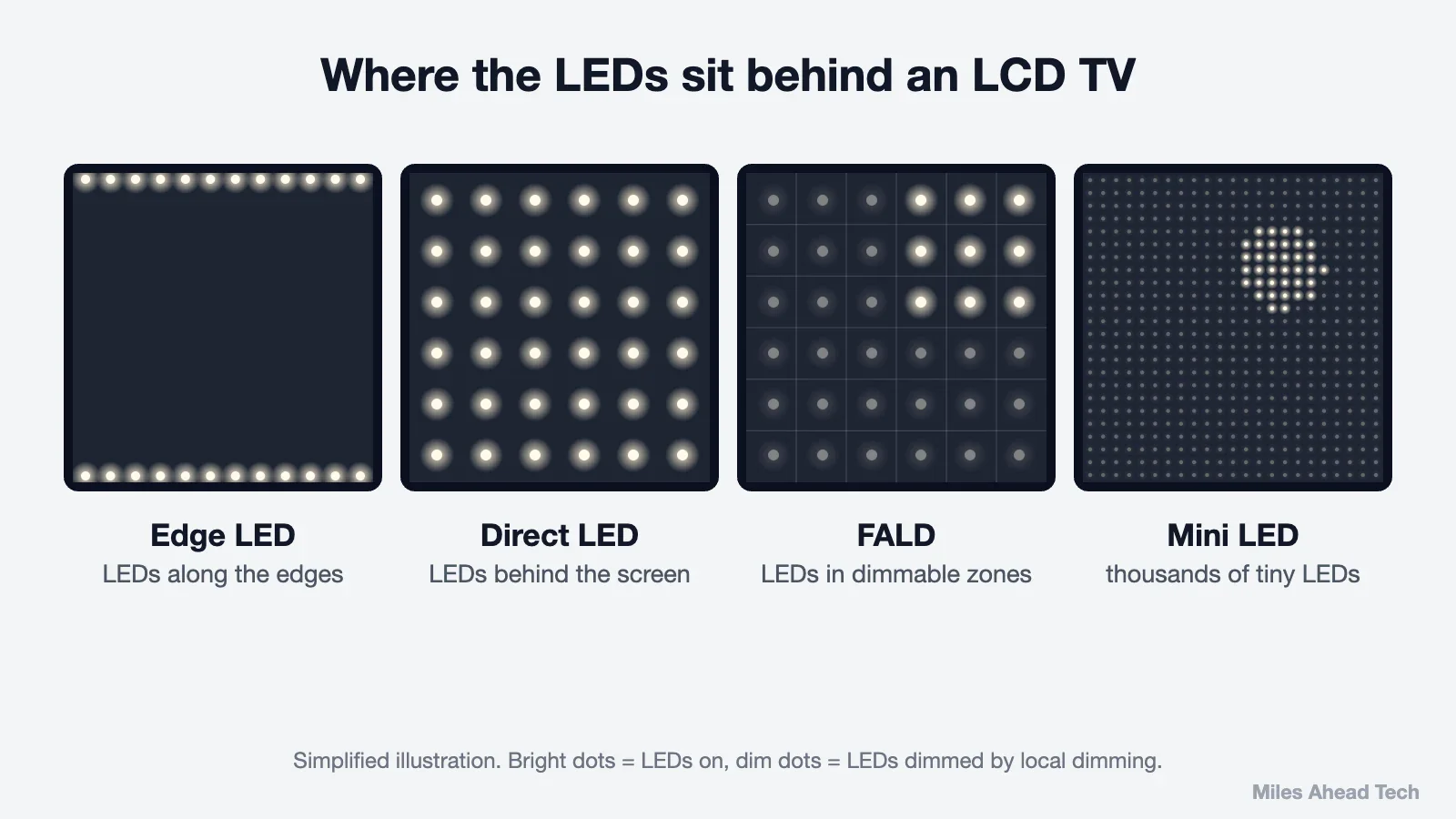
In a Direct LED, or direct-lit, TV, the LEDs are spread across the back of the display, directly behind the LCD panel. Diffuser layers between the LEDs and the panel spread the light out so you don't see a grid of bright dots. In an Edge LED TV, by contrast, the LEDs sit along one or more edges of the screen, and their light has to be guided across the panel.
Why use Direct LED
The biggest potential advantage is backlight uniformity. Because the light sources are spread out behind the screen rather than concentrated along the edges, the manufacturer doesn't have to push all the light from the edges toward the center. That makes it easier to get fairly consistent brightness across the whole panel.
That doesn't mean every Direct LED TV is perfectly uniform. Panel quality, the number and placement of LEDs, the diffuser design and manufacturing tolerances all play a part. But the basic layout gives manufacturers a simple way to light the entire display.
Direct LED TVs can also be relatively affordable
Direct LED isn't a premium technology. Basic direct-lit backlights are common in entry-level and mid-range 4K TVs, because putting LEDs behind the screen doesn't require complicated local-dimming hardware. A basic direct-lit TV may simply light the whole backlight at once, without dimming different areas independently, even though its LEDs sit in the same place as those of a more advanced full-array model.
And that's where the terminology starts to get confusing.
Direct LED vs. Full Array Local Dimming: what's the difference
This is probably the most important distinction in the whole article. Direct LED describes where the LEDs are positioned. Local dimming describes how independently those LEDs can be controlled.
A basic Direct LED TV can have LEDs spread across the entire back of the display while still treating most or all of them as one big light source. If a dark cave appears on one side of the screen and a bright lamp on the other, the TV may not be able to dim the backlight behind the cave without also dimming the lamp.
FALD adds independently controlled zones
Full Array Local Dimming, usually shortened to FALD, also places LEDs across the back of the screen. The difference is that the backlight is divided into multiple dimming zones, so the TV can lower the brightness behind dark parts of the image and raise it behind bright ones.
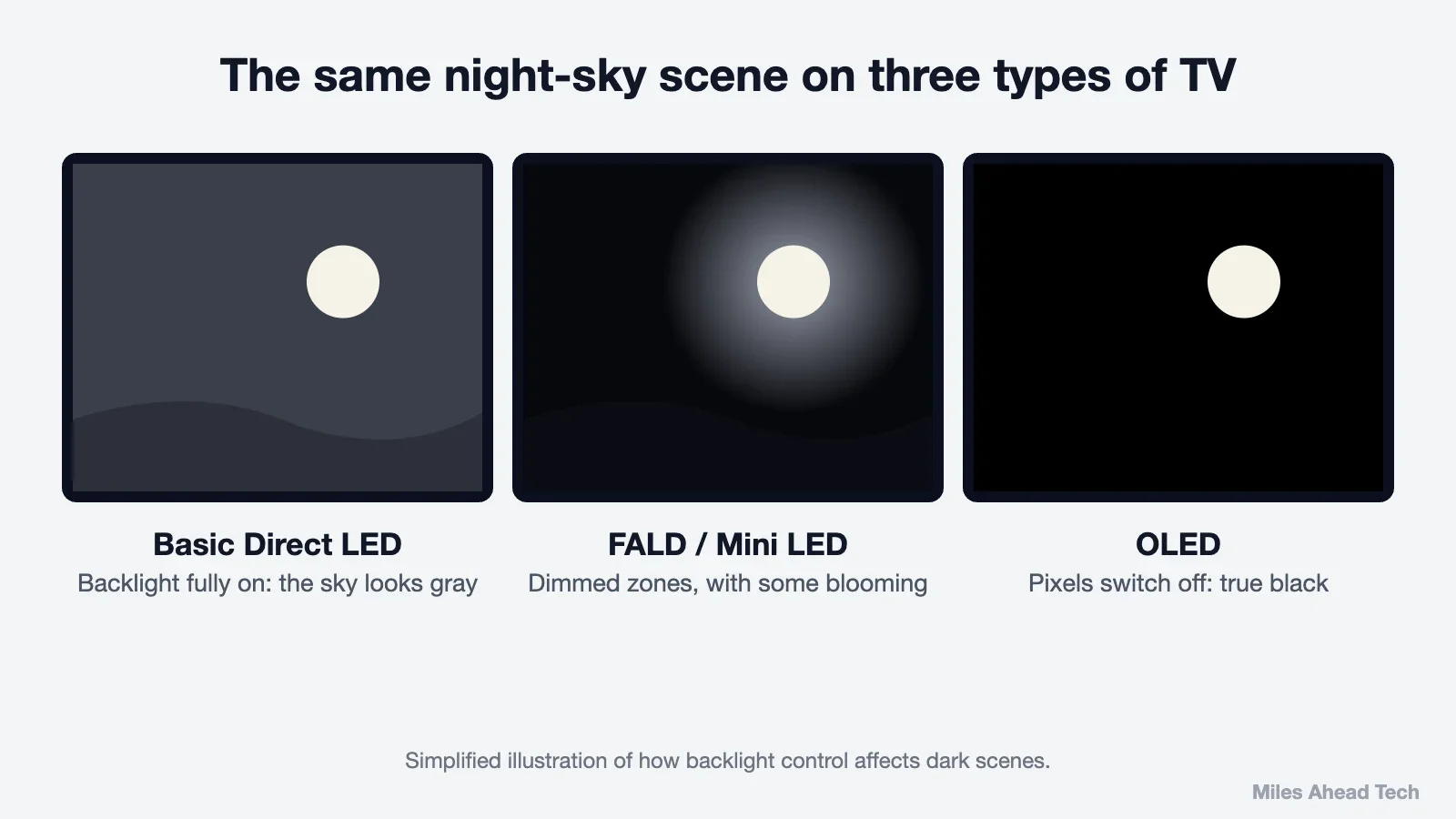
Imagine a small white moon against a black night sky. A basic Direct LED TV may keep much of the backlight on across the whole screen, so the sky looks dark gray. A good FALD TV can dim the dark sections while keeping the area behind the moon bright. The result is deeper-looking blacks, stronger contrast, more convincing HDR and dark scenes that look less washed out.
Does more local dimming always mean better picture quality
Not automatically. The number of dimming zones matters, but so does the software that controls them. A TV with poorly implemented local dimming can produce blooming, a halo of light around bright objects.
Think of white subtitles on a black background. Instead of clean white letters on black, you may see a gray glow around them, because each dimming zone is much larger than the letters it's lighting. Local dimming works best when the TV can control small areas precisely and move smoothly between them. So when you compare two FALD TVs, don't simply pick the one advertising the most zones. Real-world performance matters more.
Direct LED vs. Edge LED
Edge LED takes a different approach. Instead of spreading LEDs across the back of the TV, it places them around the edges of the display, and a light guide spreads their light across the LCD panel.
The obvious advantage is that the TV can be thinner, which is one reason Edge LED became so popular when manufacturers were competing to make slimmer sets. The downside is that, because the light starts at the edges, some TVs struggle to spread it evenly. That can lead to brighter edges, clouding, flashlighting in dark scenes and less effective local dimming.
Still, it's a mistake to assume every Direct LED TV automatically looks better than every Edge LED TV. A well-designed Edge LED TV can outperform a poorly made Direct LED model. The backlight type is only one part of the picture-quality equation.
| Technology | How it works | Main advantage | Main limitation |
|---|---|---|---|
| Edge LED | LEDs are positioned around the edges of the LCD panel | Allows very thin TV designs | Backlight uniformity and local dimming can be limited |
| Direct LED | LEDs are distributed directly behind the LCD panel | Potentially more uniform illumination | Doesn't necessarily offer local dimming |
| FALD | Rear LED backlight is divided into independently controlled zones | Better contrast and deeper blacks | Can produce blooming around bright objects |
| Mini LED | Uses much smaller LEDs and typically many more dimming zones | High brightness and precise local dimming | Usually more expensive than basic LED TVs |
| OLED | Each pixel produces its own light; no backlight is required | Perfect blacks and pixel-level contrast | Usually costs more than entry-level LCD TVs |
Direct LED vs. Mini LED
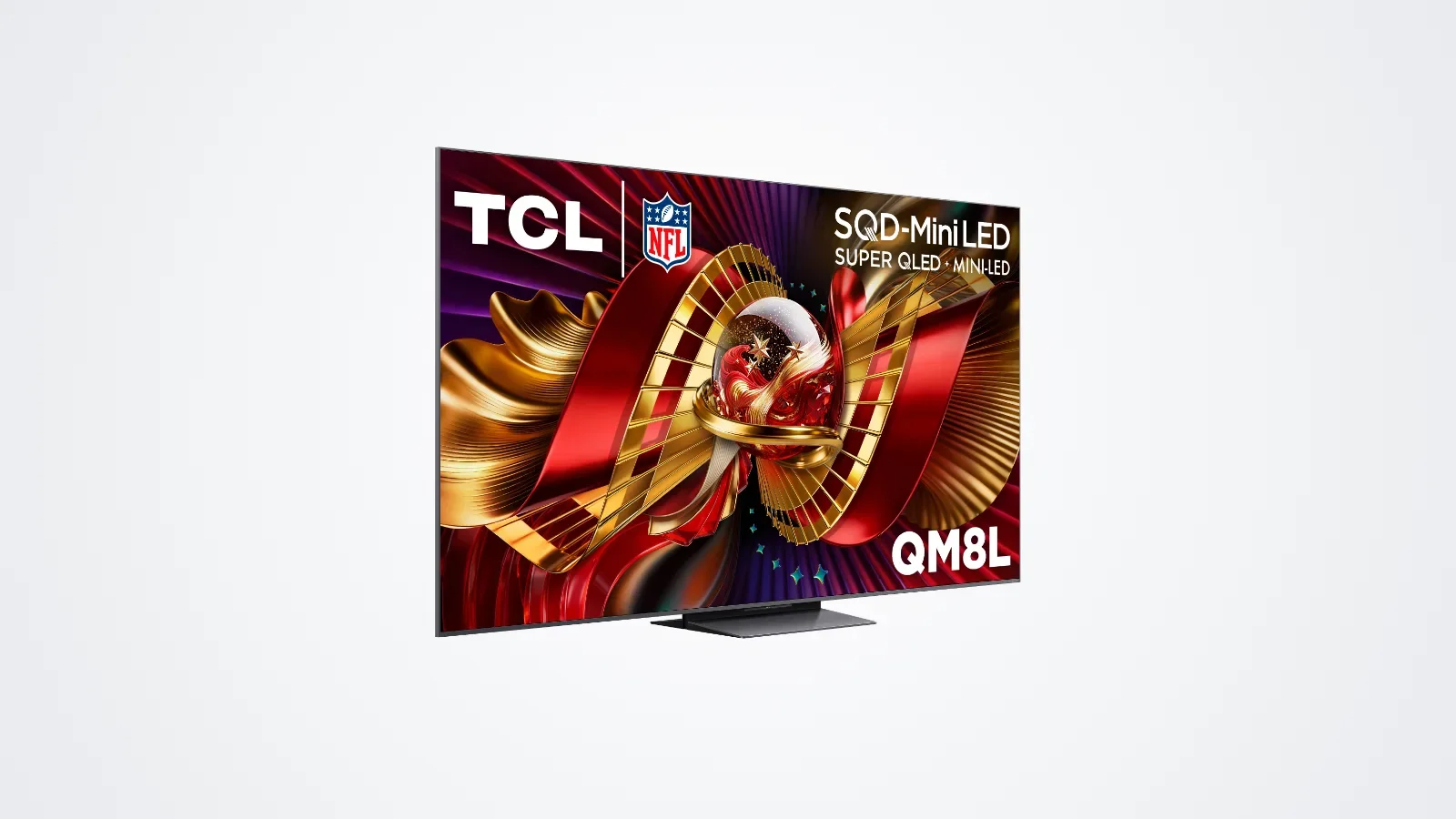
Mini LED takes the same basic idea and makes it far more sophisticated. A Mini LED TV is still an LCD TV that needs a backlight, but its LEDs are dramatically smaller. That lets manufacturers fit far more of them behind the screen and create many more local-dimming zones. Sony, for example, describes its Mini LED backlights as thousands of small, densely packed LEDs combined with local dimming for more precise control over bright and dark parts of the image.
Put very simply: Direct LED means LEDs behind the screen, FALD means LEDs behind the screen divided into controllable zones, and Mini LED means much smaller LEDs behind the screen, usually with much more precise local dimming. It's an oversimplification, but it's a useful way to understand the hierarchy. We go deeper in our article explaining what Mini-LED and MicroLED are and how they compare.
Why Mini LED matters for HDR
A good Mini LED TV can keep a small highlight, such as a headlight, an explosion or sunlight on water, extremely bright while the surrounding dark areas stay dark. That combination is crucial for convincing HDR. It's also why premium Mini LED models such as the TCL QM8L can compete surprisingly well with OLED in some situations. They don't offer pixel-level lighting control, but they get much closer than a basic Direct LED TV.
Direct LED vs. OLED
OLED works in a fundamentally different way. There's no LED backlight behind an OLED panel. Each pixel produces its own light, and when part of the picture needs to be black, those pixels simply switch off. That's why OLED can deliver effectively perfect black levels. A conventional Direct LED LCD can't do that, because even when the LCD layer tries to block the light, some of the backlight still leaks through.
Does that mean OLED is always better?
Not necessarily. OLED has big advantages in black levels, contrast, dark-room viewing, viewing angles and pixel response times. But LCD TVs, especially modern Mini LED models, can get extremely bright and are often the better choice for sunny rooms. Price, screen size and how you use the TV matter too.
The key point is that Direct LED and OLED aren't competing versions of the same backlight. OLED simply doesn't need a backlight at all. If you're leaning toward OLED, our ranking of the best OLED TVs of 2026 compares the top models, including the LG C6.
Is Direct LED good for HDR
On its own, "Direct LED" tells you very little about HDR performance, and it's one spec-sheet term I'd be careful with. It doesn't tell you how bright the TV gets, whether it has local dimming, how many zones it has, how good its contrast is or how accurately it handles HDR content.
Peak HDR brightness depends on the complete TV design, not simply on where the LEDs sit. Local dimming also lets an LED TV put more power into bright parts of the image while dimming darker areas, which improves perceived HDR contrast. So if HDR matters to you, look at measured brightness and local-dimming performance rather than treating "Direct LED" as a quality badge.
Is Direct LED good for gaming
It can be, but the backlight doesn't decide whether a TV is good for gaming. One Direct LED TV might have a 60Hz panel, no VRR, limited HDR and high input lag. Another direct-lit or full-array model could offer 120Hz or 144Hz, HDMI 2.1, VRR, ALLM and very low input lag.
When choosing a gaming TV, refresh rate, HDMI 2.1, VRR and input lag matter far more than the words "Direct LED". The backlight only becomes relevant once you start looking at contrast and HDR performance.
Does Direct LED make a TV thicker
Usually a little. Because the LEDs sit behind the LCD panel, the TV needs enough depth for the backlight and the layers that spread its light, while Edge LED designs can generally be made thinner. In practice, though, it's not something I'd prioritize. Modern Direct LED TVs are still slim enough to wall-mount easily, and unless you're trying to make your TV disappear into the wall, a bit of extra depth is a better compromise than accepting a worse picture just because the chassis looks slimmer from the side.
Should you buy a Direct LED TV
There's nothing wrong with Direct LED. It can be a perfectly good solution for an affordable everyday TV. But I wouldn't search for "the best Direct LED TV", because the label simply doesn't tell you enough about picture quality. Instead, ask:
Does it have local dimming?
What is the native contrast?
How bright does it get?
Is it 60Hz or 120Hz?
Does it support the HDR formats you use?
How good is its motion processing?
Does it have HDMI 2.1 and VRR?
Is the smart TV platform good?
If you're choosing between two inexpensive LCD TVs and one uses Direct LED while the other uses a basic Edge LED system, the Direct LED model may have the edge in backlight uniformity. Once you move into higher price ranges, though, FALD and Mini LED become far more meaningful terms. The same goes for brands: the specific model matters more than the logo, as we explain in our guide to the most popular TV brands and which one to choose.
Direct LED, Edge LED, FALD or Mini LED: which should you choose
For an inexpensive everyday TV, Direct LED is perfectly fine. If a thin design matters more than ultimate backlight performance, Edge LED can make sense too. If you watch a lot of HDR movies and want stronger contrast from an LCD TV, look for Full Array Local Dimming, and if you're spending more on a premium LCD, Mini LED is generally the technology to target. OLED remains the alternative if your priorities are perfect blacks, very strong contrast and excellent dark-room performance.
It's tempting to see this as a simple ladder, Edge LED < Direct LED < FALD < Mini LED < OLED, but TVs are more complicated than that. Knowing what each term means does make spec sheets much easier to decode. Screen size is worth thinking about too, and our guide on how to choose the right TV size for your viewing distance can help there.
In the end, Direct LED is a description of how an LCD TV is lit, not a guarantee of how good the picture will be.
FAQ
What does Direct LED mean on a TV?
Direct LED means the LEDs providing the TV's backlight are positioned directly behind the LCD panel rather than only around its edges.
Is Direct LED better than Edge LED?
Direct LED can provide more uniform lighting because the LEDs are spread behind the screen, while Edge LED allows for thinner TV designs. However, the specific TV matters more than the backlight label alone.
Is Direct LED the same as Full Array?
Not necessarily. Both place LEDs behind the LCD panel, but Full Array Local Dimming divides the backlight into separately controlled zones. A basic Direct LED TV may not have local dimming at all.
Is Direct LED the same as Mini LED?
No. Mini LED uses much smaller LEDs, which lets manufacturers fit far more light sources behind the display and usually create more precise local-dimming systems.
Is Direct LED better than OLED?
OLED has no separate backlight and can switch individual pixels completely off, which gives it a major advantage in black levels and contrast. Direct LED LCD TVs are usually cheaper and come in a very wide range of sizes and price points.
Does Direct LED have local dimming?
Sometimes, but Direct LED doesn't automatically mean local dimming. If the backlight is divided into independently controlled zones, you'll usually see terms such as Full Array Local Dimming or FALD in the specifications.
Is Direct LED good?
Yes, it can be. Direct LED is common in affordable and mid-range TVs and can provide good backlight uniformity, but it shouldn't be used as shorthand for overall picture quality.