
PlayStation or Xbox? It's one of the oldest arguments in gaming, and in 2026 the answer is less obvious than ever. Both consoles run most big releases well, Microsoft now publishes many of its games on PlayStation too, and prices for both families have gone up this year. In this guide, I'll compare the PS5, PS5 Pro, Xbox Series X and Xbox Series S across performance, storage, controllers, games, subscriptions and extra features, so you can pick the console that actually fits the way you play.
Quick answer
Choose PlayStation if you care most about Sony's own games, the DualSense controller, virtual reality or the extra graphics power of the PS5 Pro.
Choose Xbox if Game Pass, playing older Xbox games and moving between console and Windows PC matter more to you.
And if most of your friends already play on one platform, that's usually the strongest argument of all, because cross-play still doesn't cover every game.
The current lineup: PS5, PS5 Pro, Xbox Series X and Series S
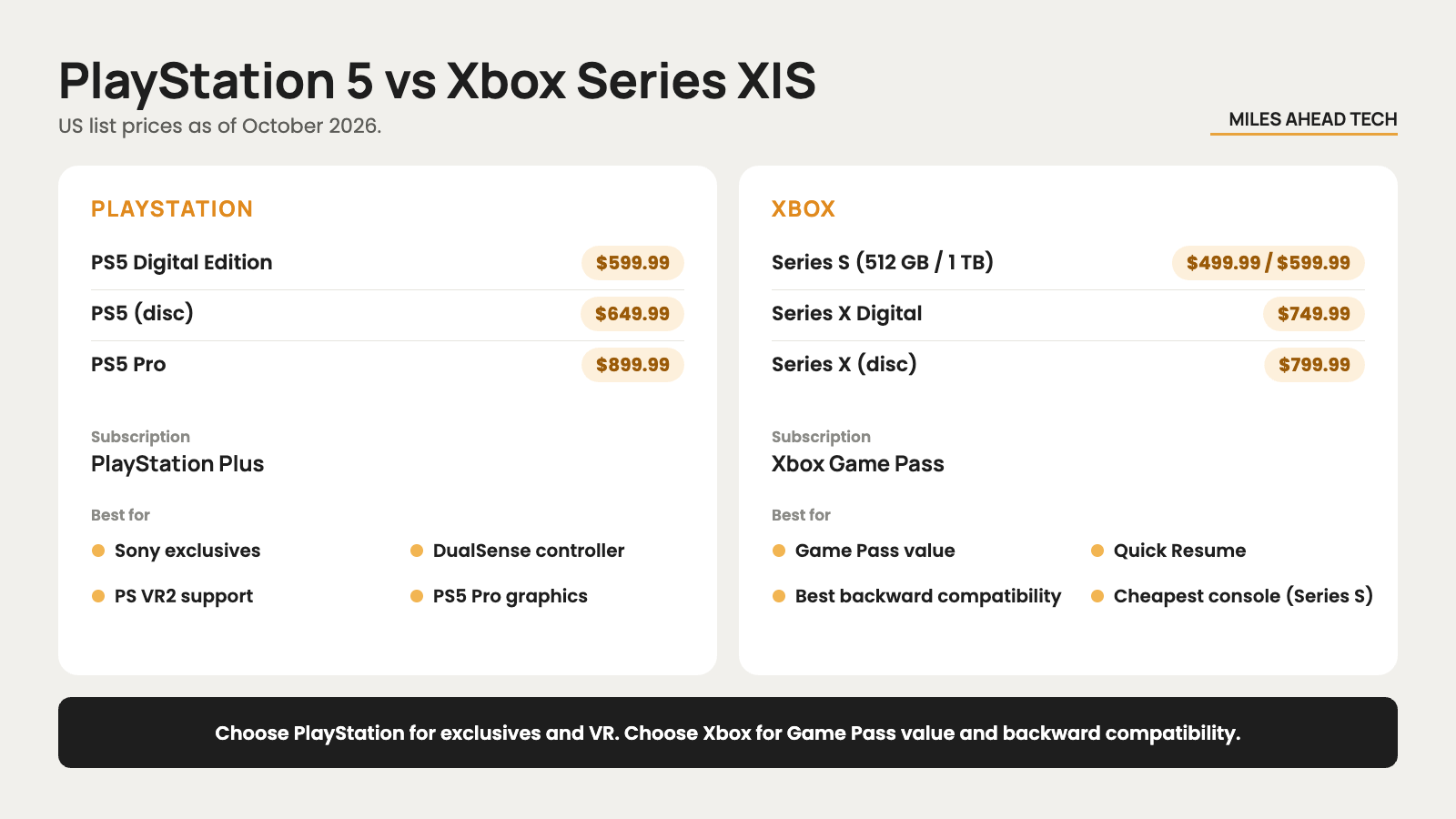
Both companies sell several versions of their consoles, and the differences between them matter more than the brand on the box. Here's how the current models compare, with official US prices after this year's increases:
| Console | US list price (Oct 2026) | Best for |
|---|---|---|
| PlayStation 5 (disc) | $649.99 | The balanced PlayStation choice, with physical and digital games and expandable M.2 storage |
| PlayStation 5 Digital Edition | $599.99 | PlayStation without a disc drive; a drive can be added later |
| PlayStation 5 Pro | $899.99 | The best graphics on console, 2 TB of storage; disc drive sold separately |
| Xbox Series X (disc, 1 TB) | $799.99 | The most powerful Xbox, aimed at 4K TVs |
| Xbox Series X Digital (1 TB) | $749.99 | Series X performance without a disc drive |
| Xbox Series S (512 GB / 1 TB) | $499.99 / $599.99 | The cheapest current console, compact and digital-only, with lower resolutions |
Prices are official US list prices and change often. Retailers may sell for less during sales.
The current generation started in November 2020 with the PS5, Xbox Series X and Xbox Series S. Sony added the PS5 Pro in November 2024, while Microsoft has so far only released new configurations of the Series X, including an all-digital version, and has no direct rival to the Pro.
If you're on a tight budget, the Series S is the cheapest way into current-generation gaming, but it's built for lower resolutions and its storage fills up quickly.
Performance and picture quality
The standard PS5 and the Xbox Series X are closer in real games than their spec sheets suggest. Most games offer a quality mode with sharper graphics at 30 fps and a performance mode that runs more smoothly at 60 fps, and some support 120 Hz.
Don't take labels like "8K" or "4K at 120 fps" on the box too literally, because demanding games rarely run at those settings natively. In practice, the difference between a game's own graphics modes is often bigger than the difference between the two consoles.
The PS5 Pro is the clear performance leader. Its stronger GPU, improved ray tracing and PlayStation Spectral Super Resolution (PSSR) upscaling let supported games look close to their quality mode while running closer to their performance mode.
The catch is that the benefit depends on the game, and titles that haven't been updated for the Pro don't gain as much. It also only makes sense with a good TV. If you're thinking about an upgrade, look for a model with HDMI 2.1, 4K at 120 Hz and VRR, like the ones in our ranking of the best OLED TVs of 2026.
Storage: how much space you really get
Modern games often take up 100 GB or more, so storage fills up faster than you'd expect. The PS5 has an advantage here: you can add a standard PCIe 4.0 M.2 NVMe SSD with a heatsink, such as the Samsung 990 PRO with Heatsink, as long as it meets Sony's requirements. That means more brands and often better prices.
Xbox Series X and Series S consoles use proprietary expansion cards that plug into the back of the console, such as the SanDisk Optimus GX Storage Expansion Card. A regular USB drive can store Series X|S games and run many older Xbox titles, but games optimized for the new consoles have to be played from internal storage or an expansion card. Our ranking of the best external SSDs can help if you just want somewhere to keep games you're not playing right now.
It's also worth deciding whether you want a disc drive. Discs let you buy used games, lend them to friends and keep a physical collection, although many new releases still need a download or an online activation. With a digital-only console, every purchase is tied to your account and that platform's store.
Controllers
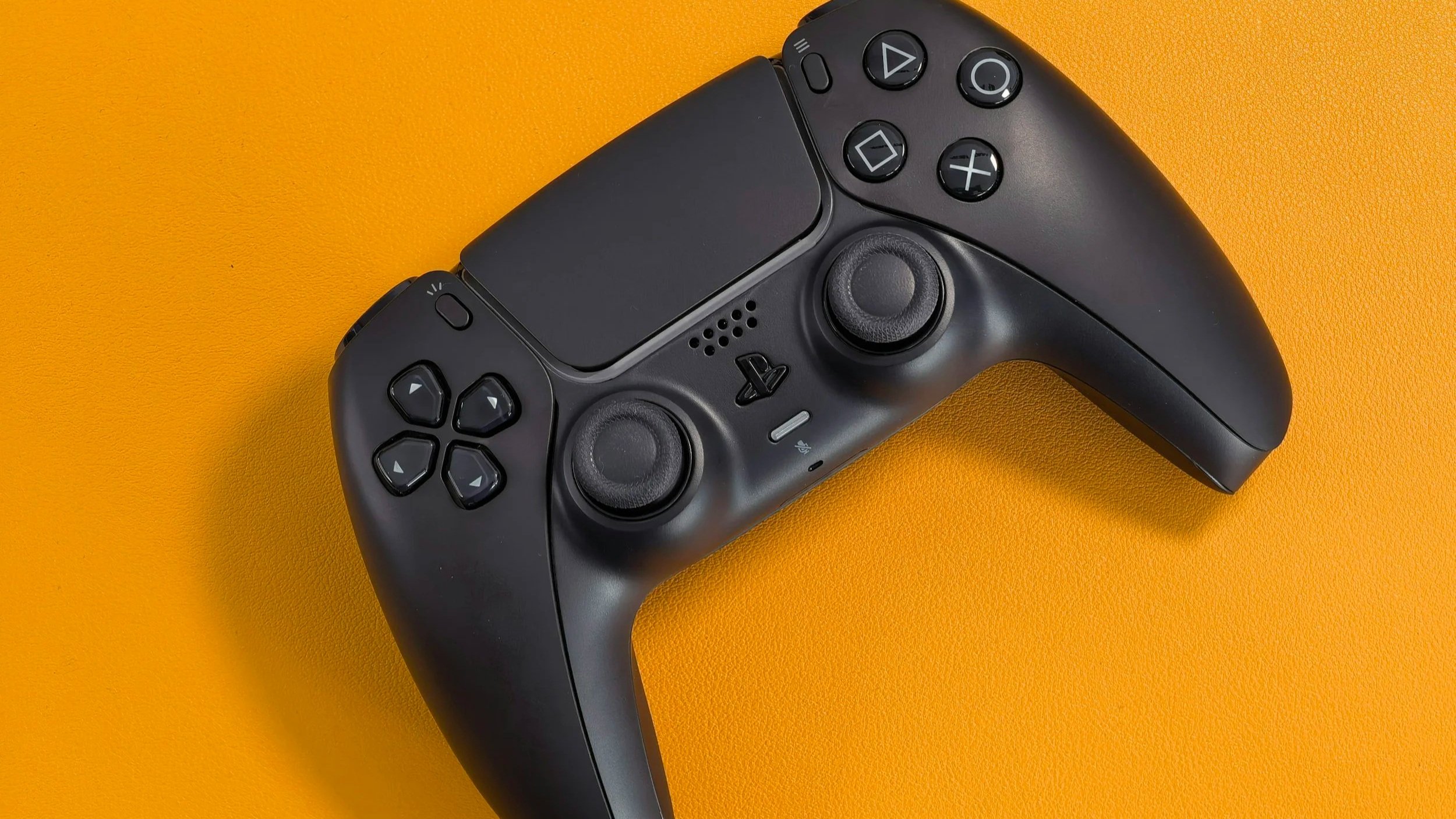
I believe that the DualSense is PlayStation's biggest hardware advantage. In supported games, its detailed haptic feedback and adaptive triggers let you feel things like tension in a bowstring or the texture of the road, and it also has a touchpad, motion sensors, a speaker and a built-in microphone. If the effects aren't for you, you can turn them down or switch them off.
The Xbox Wireless Controller has offset thumbsticks, impulse triggers, a great D-pad and a Share button. It still runs on AA batteries, a rechargeable pack or a USB-C cable, and it works just as well on a Windows PC and many phones, which makes it a favorite of PC players.
Both companies also sell premium pads with remappable buttons and back paddles: the DualSense Edge for PlayStation and the Xbox Elite Series 2 Core for Xbox. For players with limited mobility, the Xbox Adaptive Controller and the PlayStation Access controller support custom setups.
Games and exclusives
PlayStation is still the place for Sony's own series, including Astro Bot, Gran Turismo, Marvel's Spider-Man, God of War, Horizon, The Last of Us and Ghost of Tsushima. Many of them come to PC eventually, so "exclusive" often means console exclusive, or exclusive for a while, rather than forever.
Xbox has Forza, Halo, Microsoft Flight Simulator and games from Bethesda, Activision Blizzard, id Software and Obsidian. However, Microsoft now releases a lot of its games on PlayStation as well, with Sea of Thieves and Forza Horizon 5 among them.
That makes exclusives a much weaker reason to buy an Xbox than it used to be, and a stronger reason to look at Game Pass and the rest of the ecosystem instead. Most big third-party games now support cross-play, but not all of them do, and progress doesn't always carry over between platforms, so check the games your friends play before you buy.
Game Pass vs PlayStation Plus
Both consoles have a subscription that you'll probably end up paying for, because most paid games need it for online multiplayer. Free-to-play games like Fortnite and Call of Duty: Warzone don't.
Xbox Game Pass comes in several tiers, starting at $9.99 per month for Essential, which includes online multiplayer and a small library. Higher tiers add a bigger catalog, PC games and cloud gaming, and Ultimate is the only tier that gets new Microsoft games on the day they launch. If you like trying lots of games, especially on both console and PC, Game Pass is Xbox's strongest selling point.
PlayStation Plus has three tiers. Essential covers online play, monthly games and cloud saves, Extra adds a catalog of hundreds of PS4 and PS5 games, and Premium adds classic games, game trials and cloud streaming. We explain the differences and prices in detail in our guide to what PlayStation Plus is and which plan to choose. With both services, remember that you don't own catalog games, and they can leave the service.
Backward compatibility
Xbox is the better choice if you have a collection of older games. The Series X and Series S play a huge number of Xbox One games, plus selected Xbox 360 and original Xbox titles, and some of them even get Auto HDR or higher frame rates. To use your old discs, you'll need a Series X with a disc drive.
The PS5 plays almost all PS4 games, and some run better thanks to patches or Game Boost. Older PlayStation generations are mostly available through remasters and the Classics catalog in PlayStation Plus Premium, which depends on the game and your region.
Virtual reality
If you're interested in VR, the decision is simple, because PlayStation is the only one of the two with a dedicated headset. PlayStation VR2 works with the PS5 and supports games like Horizon Call of the Mountain, Gran Turismo 7 and No Man's Sky.
An official adapter also lets you use it with a PC, although the experience isn't the same as on PS5. Xbox doesn't support any VR headset, so if VR matters more than consoles, it's worth comparing PS VR2 with standalone headsets like Meta Quest.
Extra features: Quick Resume, remote play and cloud gaming
Xbox's Quick Resume lets you pause several games at once and jump back into them in seconds, which is great if you switch between games often. On PS5, Activities and Game Help can take you straight to a specific mission or show tips without leaving the game.
Both consoles let you stream games from your console to a phone, tablet or PC at home. Sony also sells the PlayStation Portal, a handheld made for remote play, which can also stream some games from the cloud for PlayStation Plus Premium members. Cloud gaming is available in the higher Game Pass and PlayStation Plus tiers, but a stable connection and a nearby data center matter more than raw internet speed.

Which console should you buy?
PS5 if Sony's games, the DualSense controller, PS VR2 or an existing PlayStation library are your priorities.
PS5 Pro if you have a good 4K TV with 120 Hz, care about ray tracing and sharp, smooth graphics, and don't mind the high price and the separate disc drive.
Xbox Series X if Game Pass, backward compatibility, Quick Resume, physical Xbox games and Windows PC integration matter most.
Xbox Series S if the lowest price and small size matter more to you than resolution, a disc drive and storage space.
Neither if you want the widest choice of stores, mods, keyboard and mouse support and upgradeable hardware. In that case, a gaming PC may suit you better.
And if you already own one of these consoles, think carefully before switching. Your friends, your games, your saves and your accessories are often worth more than a small difference in hardware.
Buying checklist
List the five games you want to play most and check which platforms they're on.
Ask which console your friends play on, and check cross-play support for your favorite games.
Decide whether discs and used games matter to you.
Add up the cost of the console, extra storage, a second controller and three years of subscriptions.
Check that your TV supports HDMI 2.1, 4K at 120 Hz, VRR and HDR.
Try both controllers if you can, especially if you have accessibility needs.
Final thoughts
For most people, the games and the people they play with matter much more than small differences in specs. PlayStation is the stronger choice for Sony's games, the DualSense, VR and the image quality of the PS5 Pro. Xbox makes more sense if you love Game Pass, older games, Quick Resume and playing on a PC too. Whichever you choose, start with the games you want to play, and then pick the console that runs them.
