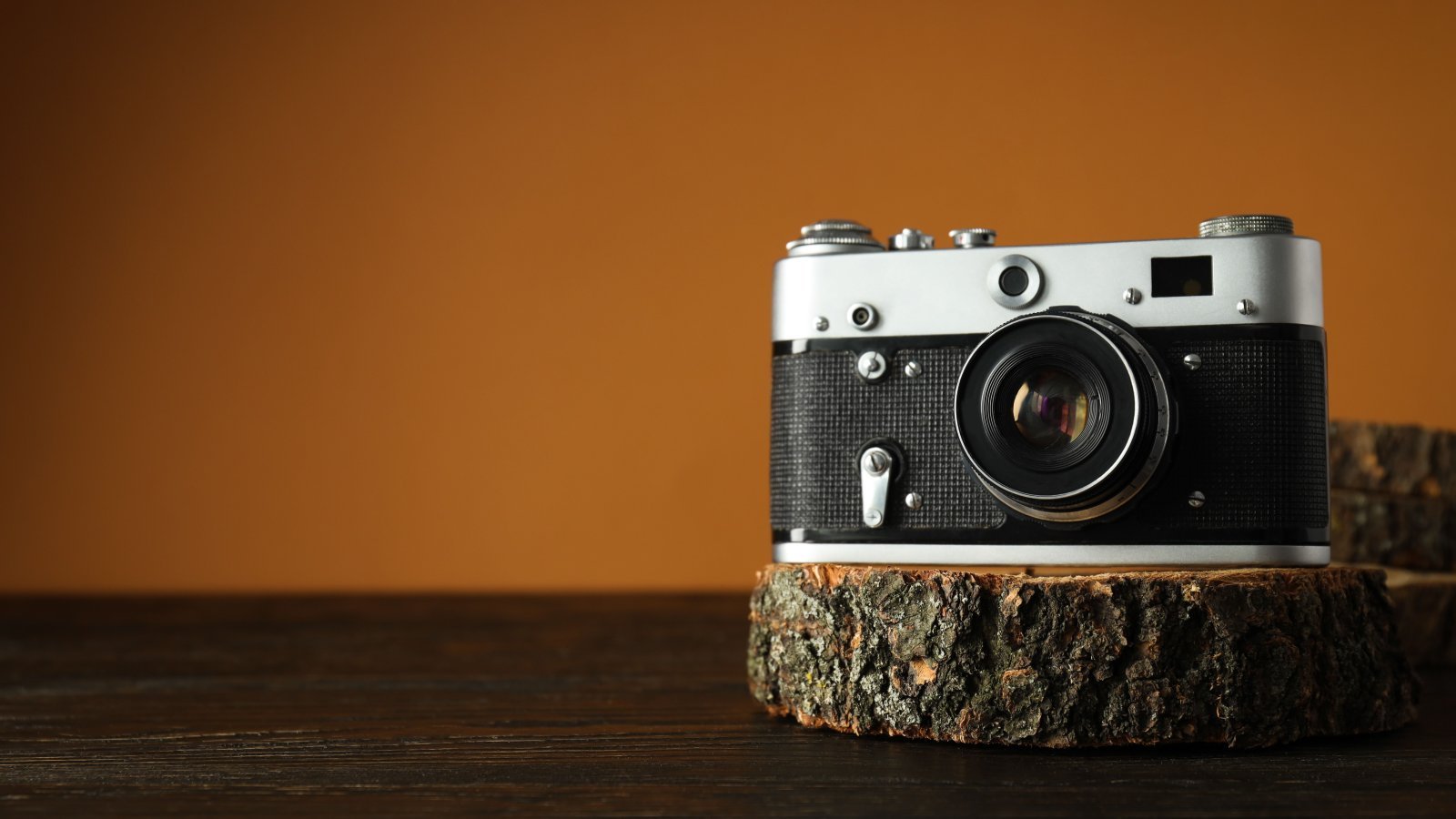
Today, billions of photos are taken every day, almost all of them on phones. But the camera took centuries to get here, from a dark room with a tiny hole to computational cameras that combine several shots in a fraction of a second. In this article, I'll tell the story of the first camera, the people who made photography possible and the milestone cameras that changed how we capture the world.
Short answer: no single person invented the camera. The camera obscura gave us the optics, Nicéphore Niépce made the oldest surviving camera photograph around 1826 to 1827, and Louis Daguerre and William Henry Fox Talbot turned photography into practical processes in 1839.
Who invented the camera?
The answer depends on what you mean by "camera". The modern camera grew out of centuries of work in optics, chemistry, mechanics and later electronics. A camera obscura could project an image but couldn't save it. Niépce found a way to make a camera image permanent. Daguerre and Talbot made photography practical enough for other people to use, and companies like Kodak, Leica and Polaroid later made it part of everyday life.
Before photography: the camera obscura
The basic idea is ancient. When light passes through a small hole into a dark room, it projects an upside-down image of the outside world onto the opposite wall. Chinese philosopher Mozi and Aristotle described the effect more than 2,000 years ago, and the Arab scholar Ibn al-Haytham studied it in detail in his Book of Optics in the early 11th century.
By the Renaissance, the camera obscura had become a tool. Lenses made the image brighter and sharper, and portable boxes with mirrors let artists trace landscapes and buildings. The image was beautiful, but it disappeared as soon as the light changed. The missing piece was a way to capture and save it, as there were no memory cards back then.
Niépce, Daguerre and Talbot: the birth of photography
French inventor Nicéphore Niépce made the oldest surviving camera photograph, "View from the Window at Le Gras", around 1826 to 1827. He coated a pewter plate with bitumen, a substance that hardens in light, and exposed it in a camera obscura.
The camera had to stay perfectly still, so it needed a steady support, much like a tripod today, and Niépce aimed it out of an upstairs window of his estate to catch as much light as possible. Even so, the exposure took hours, possibly even days. The result is faint, but it's the first permanent image of a real scene taken with a camera.
Niépce later worked with Louis Daguerre, who continued after Niépce's death and developed the daguerreotype. It produced a highly detailed image on a silver-coated copper plate with a much shorter exposure. In 1839, the French government announced the process and made it free to use in most of the world, and that year is usually seen as the public birth of photography.
At the same time in England, William Henry Fox Talbot developed a paper-based process. His later calotype created a negative from which you could print many positive copies. Daguerreotypes were sharper, but they were one-of-a-kind. Talbot's negative-positive idea became the basis of film photography for the next 150 years.
Milestone cameras that changed photography
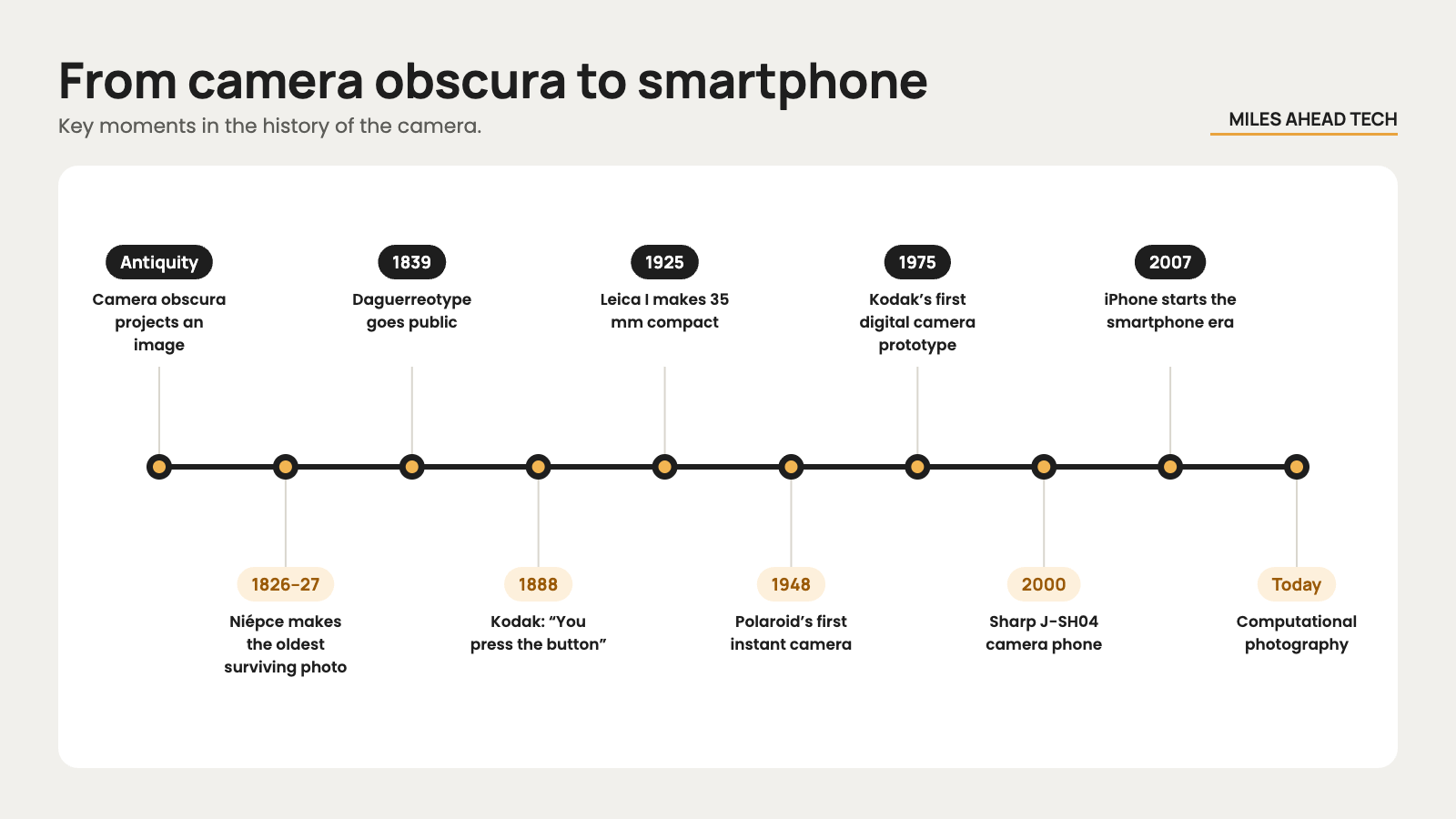
From then on, cameras became smaller, cheaper and easier to use. These are some of the most important milestones:
| Year | Camera | Why it mattered |
|---|---|---|
| 1839 | Giroux daguerreotype camera | Often called the first commercially produced camera, though big, expensive and difficult to use |
| 1888 | Kodak camera | "You press the button, we do the rest": roll film for 100 photos, developed by mail |
| 1925 | Leica I | Made 35 mm film practical for compact cameras and changed street and travel photography |
| 1948 | Hasselblad 1600F | Modular medium-format system; later Hasselblads went to the Moon with Apollo |
| 1948 | Polaroid Land Camera Model 95 | The first commercially successful instant camera |
| 1972 | Polaroid SX-70 | Folding instant SLR with integral film that developed without peeling |
| 1975 | Kodak digital prototype | Steven Sasson's 3.6 kg camera recorded 0.01-megapixel black-and-white images to tape |
| 1981 | Sony Mavica prototype | Electronic still camera that saved images to magnetic disks instead of film |
| 2000 | Sharp J-SH04 | One of the first commercially successful camera phones, sold in Japan |
| 2007 | iPhone | Combined a camera with a touchscreen, internet and later apps, starting the smartphone photo era |
From film to digital
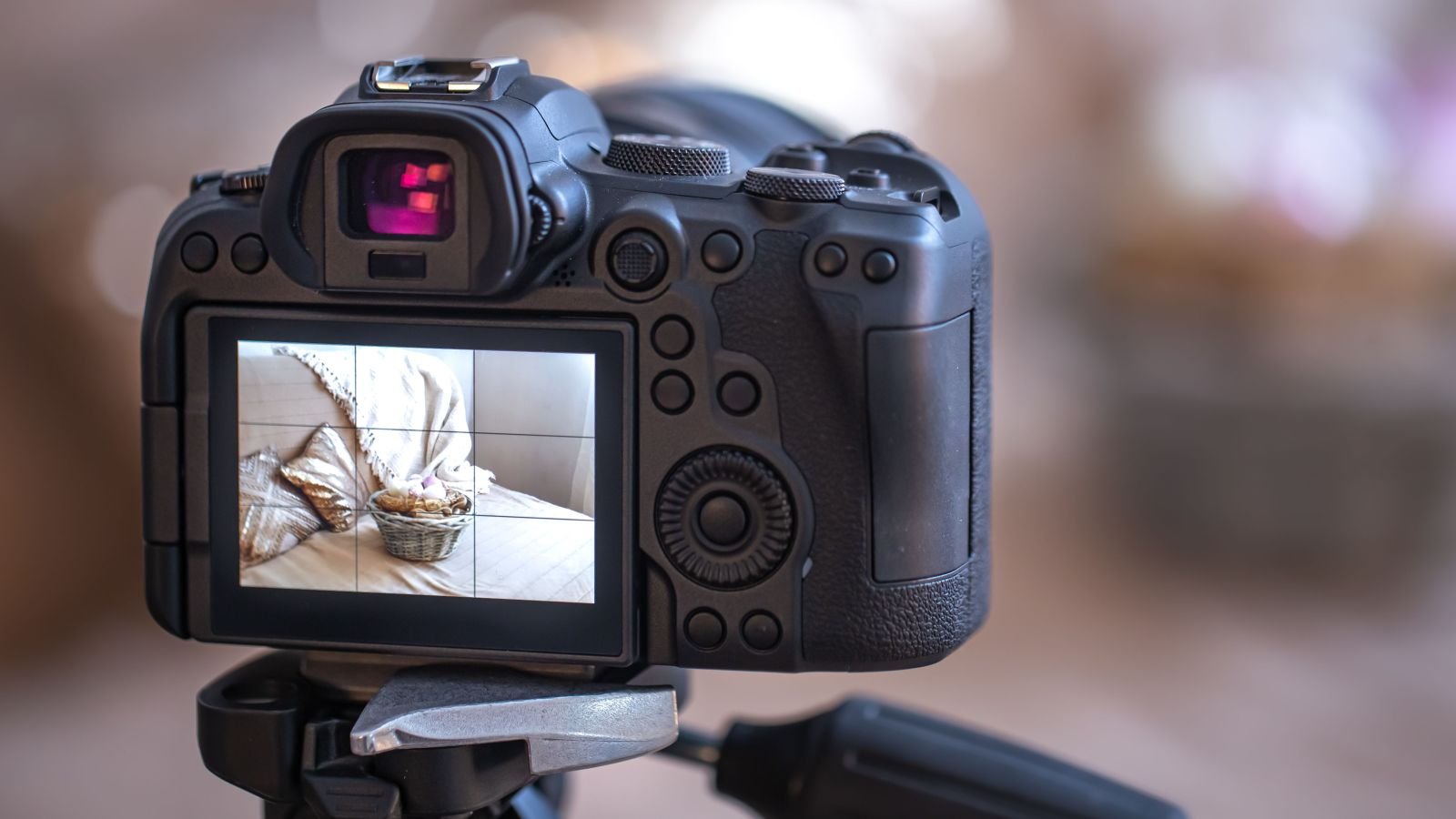
Digital photography became possible with image sensors. First CCD and later CMOS sensors replaced film with millions of tiny photosites that turn light into electrical signals. Memory cards replaced film rolls, and image processors took over the work of the darkroom.
The change happened gradually. Early professional digital cameras were extremely expensive, and film stayed popular through the 1990s. In the 2000s, affordable compact cameras, digital SLRs, better screens and home computers made digital the standard for both amateurs and professionals.
You've probably heard that Kodak invented digital photography and then ignored it. The real story is more complicated. Kodak built and sold digital cameras, sensors and professional systems, but it struggled to replace its very profitable film business and keep up with fast-moving electronics companies. It filed for bankruptcy protection in 2012 and later continued as a smaller, reorganized company.
The smartphone era and computational photography
The first iPhone in 2007 wasn't the first camera phone, and its camera was basic. What changed everything was the combination of an always-connected camera, a touchscreen and apps for editing and sharing. Within a few years, smartphones replaced compact cameras for most people.
Smartphones do far more than put a small camera in a phone. Multiple lenses, stacked sensors and dedicated image processors work with computational photography: a single press of the shutter can combine several exposures, balance light and shadows, reduce noise and recognize subjects.
The phone is now a camera, editing studio and publishing platform in one. Cloud services like Google Drive and Google Photos keep decades of photos backed up and searchable, and our guide on where to store your phone photos compares the options.
Has photography lost its magic?
Photography has become easier to make but harder to stand out. With billions of images shared every day, a good photo still depends on the same things it always did: light, timing, composition and a reason to take the picture. And generative AI raises new questions about authenticity, which makes keeping original files and being honest about edits more important than ever. If you need a simple place to keep those originals safe, our explainer on what Google Drive is and how it works is a good place to start.
Many photographers are also rediscovering slower formats. Film and instant photography are popular again because every shot feels more deliberate. An instant camera like the Polaroid Now+ Gen 2 connects you to the same thrill people felt in 1948: watching a real photo appear in your hands.
Final thoughts
There was never a single "first camera". The camera obscura gave us the image, Niépce made it permanent, and Daguerre and Talbot made photography practical. From there, Kodak, Leica, Polaroid, digital sensors and smartphones each made photography easier and more personal. If you want to make the most of the camera in your pocket, read our guide on how to take better photos with your phone.
